
Speakers
Four words cover the whole addon:
| Decides | |
|---|---|
| Conversation | what is said |
| Speakers | who says it |
| Dialogue Box | how it is presented |
| Placement | where it appears |
This page is the second one.
A speaker is a dialogue identity
Not a gameplay character. A speaker holds a name, a face for the box, and a voice, and nothing else. No NodePath, no AnimationPlayer, no world sprite.
That is why a narrator, a radio voice, a sign, or a character in a level that is not even loaded are all ordinary speakers. There is nothing to point them at.
Making one
Open the Speakers tab of the TalkKit workspace and press + New. The pane in the middle edits the speaker, and the preview shows how the box will draw them.
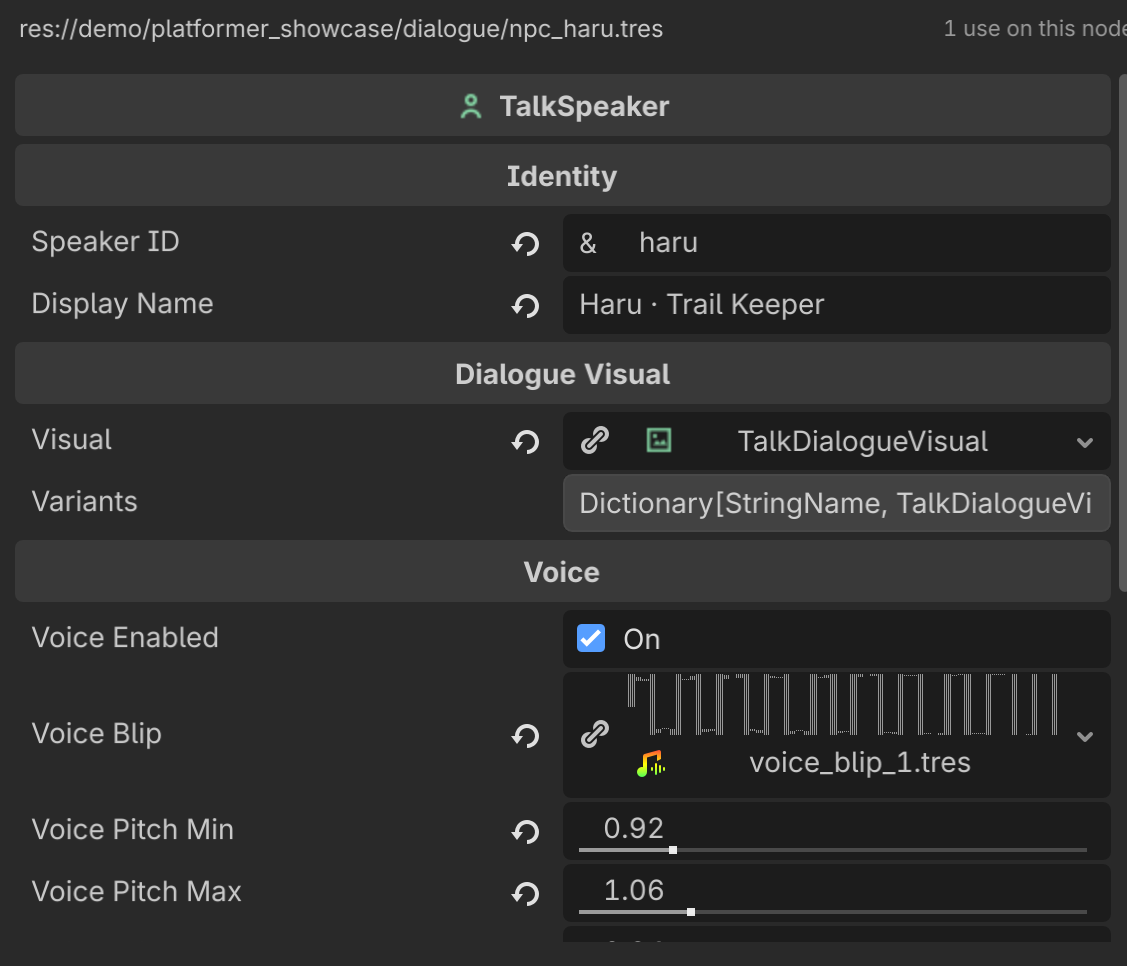
| Field | What it is |
|---|---|
| Display Name | the name on the box, such as Haru · Trail Keeper |
| Visual | the face in the box: a Texture for a still portrait, or Sprite Frames and an Animation for an animated one |
| Variants | other named faces, such as angry or happy |
| Voice Blip, Voice Pitch Min/Max, Voice Blip Interval | the short sound played as letters appear; ▶ Preview voice blip plays it |
A speaker made here is local to the node. Actions → Save as Shared… writes it to a .tres so other NPCs can use the same one; edit it once and every NPC that uses it changes. Make Unique lets one NPC go its own way.
The player is a speaker too
Point the player's speaker at the very SpriteFrames the player character already uses, and the box shows the same animation. TalkKit reads the resource, never the node, which is why this works even when the player is nowhere in the scene.
TalkKit does not control your characters
It never maps a speaker onto a node, never plays a talk or idle animation, never reads gameplay state. If you want the character to animate while it talks, your game plays that animation, next to where it starts the conversation.
Named faces
Add faces under Variants, then pick one on a line with Visual variant in the line's options. A variant the speaker does not have falls back to their default face rather than drawing nothing, so a line written for an angry Haru still plays against a Haru with only one face.
Several speakers, one conversation
A conversation says once who normally speaks. A line says so only when it is the exception, and the line after it goes back to the default on its own.
Defaults    Haru              Classic Panel     Screen · Bottom

1   H   Haru     Defaults            The road is dangerous.
2   H   Haru     Defaults            Stay close.
3   R   Ren      2 overrides         Wait!
4   H   Haru     Defaults            What is it?
To make line 3 Ren's, click the H beside it and pick Ren, or select the line and set Speaker in its options. There is no cast to declare and no roster to set up: several speakers is not a mode, it is what happens when a line names someone else.
The choices are the same everywhere:
| Default (Haru) | use the conversation's speaker |
| None · narrator | nobody speaks this line |
| Haru, Ren, Player… | the speakers this node has |
To use a speaker the node does not have yet, add it in Speakers first. The conversation's Defaults row also has Browse…, for a speaker saved anywhere in the project.
Two levels, and only two
line → conversation defaultThat is the whole rule, for the speaker, the box and the placement alike. The node holds the list to pick from; it is not a third level that decides what a conversation left out.
This is still not branching
One conversation is one straight sequence. Several speakers change the name on the box; they do not change what runs next. Branching stays where it was: your game answers a blocking event and starts another conversation.
Picking, not editing
A conversation and a line only pick a speaker or a box. Making, duplicating, sharing and deleting them happens in the Speakers and Dialogue Boxes tabs, where each shows who uses it.
Picking Ren for one line is local; Ren is not. Editing Ren in Speakers changes every line and every NPC that uses that speaker. Want a red variant of the Speech Bubble for one line? Duplicate it in Dialogue Boxes, rename it, and pick it on the line.
Nobody speaking
Set Speaker to None · narrator. The text still types and events still fire; the name and the face stay empty, which is what a sign, a narrator or a system message should look like.
Rich text
A line is rich text. Type Godot's BBCode straight into it:
[color=red][b]Warning![/b][/color] Go back.The typewriter reveals the words, never the tags, so a half-typed line never shows [colo. BBCode is the whole vocabulary; TalkKit adds no markup of its own.
Text with nothing written in advance
say() shows a line straight from code: a bark, a hint, a narrator line about something that just happened. It takes a string, a line, or a list of them.
$NPCTalkKit.say("[i]The river carries you back to the trailhead.[/i]")A node with zero conversations is a working node. The line runs through the same box, placement, events and rules as a written conversation. In Quick Say in the node's Inspector, pick the speaker, box and placement say() uses.
What goes where
| Speaker | Dialogue Box | |
|---|---|---|
| The name shown | ✅ provides it | ✅ decides whether to show it |
| The face shown | ✅ provides it | ✅ decides size, side, whether to show it |
| Voice blips | ✅ the sound | — |
| Typing speed | — | ✅ |
From a script
Everything above can also be built in GDScript, for speakers made at run time.
A speaker:
extends Node

## Docs: /guide/speakers — who is talking, how they look, how they sound.

func _ready() -> void:
	_build()


#region speaker
# A speaker is a dialogue identity. No NodePath, no AnimationPlayer, no world
# sprite — so a narrator, a radio voice, or someone standing in a level that is
# not even loaded are all ordinary speakers.
func make_a_speaker() -> TalkSpeaker:
	var haru := TalkSpeaker.new()
	haru.speaker_id = &"haru"
	haru.display_name = "Haru"
	haru.visual = TalkDialogueVisual.new()
	haru.visual.texture = preload("res://addons/npc_talkkit/icons/talk_speaker.svg")
	haru.voice_blip = AudioStreamWAV.new()
	return haru
#endregion


#region reuse
# Separate from the node is not the same as separate from the asset. Pointing a
# speaker at the very SpriteFrames the player already uses is the intended way
# to make the player a speaker — TalkKit never looks for the player node.
func reuse_the_game_art(frames: SpriteFrames) -> TalkSpeaker:
	var player := TalkSpeaker.new()
	player.speaker_id = &"player"
	player.display_name = "Player"
	player.visual = TalkDialogueVisual.new()
	player.visual.sprite_frames = frames
	player.visual.animation = &"idle"
	return player
#endregion


#region variants
# Named faces, not a free-text mood. A variant the speaker does not have falls
# back to their default face rather than drawing nothing.
func add_an_angry_face(haru: TalkSpeaker, angry: Texture2D) -> void:
	var variant := TalkDialogueVisual.new()
	variant.texture = angry
	haru.variants[&"angry"] = variant


func shout_this_line(line: TalkLine) -> void:
	line.visual_variant = &"angry"
#endregion


#region multi
# One conversation, several speakers, one straight sequence. The conversation
# says once who normally speaks; a line says so only when it is the exception,
# and the line after it goes back to the default without being told to.
func a_conversation_with_three_people(
	haru: TalkSpeaker, guard: TalkSpeaker, player: TalkSpeaker, box: TalkBoxTemplate,
) -> TalkConversation:
	var conversation := TalkConversation.new()
	conversation.conversation_id = &"gate"
	conversation.default_speaker = haru
	conversation.default_dialogue_box = box
	for pair in [[null, "Who are you?"], [guard, "Step away."],
			[player, "I am only passing through."], [null, "Let him go."]]:
		var line := TalkLine.new()
		if pair[0] != null:
			line.speaker_mode = TalkLine.SpeakerMode.SPEAKER
			line.speaker = pair[0]
		line.text = pair[1]
		conversation.lines.append(line)
	return conversation
#endregion


#region nobody
# No speaker at all is a working configuration, not a gap. The text still
# types, events still fire; the name row and the visual just stay empty.
func a_sign_nobody_speaks(box: TalkBoxTemplate) -> TalkConversation:
	var conversation := TalkConversation.new()
	conversation.conversation_id = &"sign"
	conversation.default_speaker = null      # nobody, and that is the point
	conversation.default_dialogue_box = box
	var line := TalkLine.new()
	line.text = "[i]The gate is barred.[/i]"
	conversation.lines = [line]
	return conversation
#endregion


#region say
# Nothing has to be authored anywhere. say() takes a string, a TalkLine, or a
# sequence of them, and runs them through the pipeline play() uses — same box,
# same placement, same events.
func bark(text: String) -> void:
	$NPCTalkKit.say(text)


func interrupt(guard: TalkSpeaker) -> void:
	var line := TalkLine.new()
	line.text = "[color=#ff6b6b]Stop right there![/color]"
	line.speaker_mode = TalkLine.SpeakerMode.SPEAKER
	line.speaker = guard
	$NPCTalkKit.say(line)


# Or name them by id, from the collections this node carries. An option is a
# selection, never a description: say() cannot build a speaker or restyle a box.
func interrupt_by_name() -> void:
	$NPCTalkKit.say("[color=#ff6b6b]Stop right there![/color]",
		{}, {"speaker": &"guard", "dialogue_box": &"warning"})


# The key is what counts, not the value. Leaving "speaker" out falls through to
# the Quick Say default; passing it as null says there is no speaker at all.
func narrate(text: String) -> void:
	$NPCTalkKit.say(text, {}, {"speaker": null})
#endregion


func _build() -> void:
	var talk := NPCTalkKit.new()
	talk.name = "NPCTalkKit"
	talk.dialogue_boxes = [_instant_box()]
	add_child(talk)


func _verify() -> Array[String]:
	var failures: Array[String] = []
	var talk: NPCTalkKit = $NPCTalkKit

	var haru := make_a_speaker()
	var guard := TalkSpeaker.new()
	guard.speaker_id = &"guard"
	guard.display_name = "Guard"
	var player := TalkSpeaker.new()
	player.speaker_id = &"player"
	player.display_name = "Player"
	var box: TalkBoxTemplate = talk.dialogue_boxes[0]
	talk.speakers = [haru, guard, player]
	talk.quick_say_speaker = haru
	talk.quick_say_dialogue_box = box

	var gate := a_conversation_with_three_people(haru, guard, player, box)
	talk.conversations = [gate, a_sign_nobody_speaks(box)]

	talk.play(&"gate")
	for expected in ["Haru", "Guard", "Player", "Haru"]:
		if talk._box.get_name_label().text != expected:
			failures.append("speakers: expected %s, got '%s'"
				% [expected, talk._box.get_name_label().text])
		talk.advance()
	if talk.is_running():
		failures.append("speakers: the sequence should have finished")

	# A named face, and a name that does not exist.
	add_an_angry_face(haru, PlaceholderTexture2D.new())
	shout_this_line(gate.lines[0])
	if talk.resolve_dialogue_visual(haru, gate.lines[0]) != haru.variants[&"angry"]:
		failures.append("speakers: a named variant should be chosen")
	gate.lines[0].visual_variant = &"nonexistent"
	if talk.resolve_dialogue_visual(haru, gate.lines[0]) != haru.visual:
		failures.append("speakers: an unknown variant should fall back, not blank out")
	gate.lines[0].visual_variant = &""

	# Nobody speaking.
	talk.play(&"sign")
	if talk.resolve_speaker(talk.conversations[1].lines[0]) != null:
		failures.append("speakers: a sign must resolve to no speaker")
	if talk._box.get_name_label().visible:
		failures.append("speakers: and show no name row")
	talk.stop()

	# Reusing game art, with no reference to any node.
	var frames := SpriteFrames.new()
	frames.add_animation(&"idle")
	frames.add_frame(&"idle", PlaceholderTexture2D.new())
	var reused := reuse_the_game_art(frames)
	if reused.visual.frame_texture(0.0) == null:
		failures.append("speakers: an animated visual must resolve a frame")

	# say(), with nothing authored, falling through to the Quick Say defaults.
	var blank := NPCTalkKit.new()
	var quick := _instant_box()
	blank.dialogue_boxes = [quick]
	blank.speakers = [haru]
	blank.quick_say_speaker = haru
	blank.quick_say_dialogue_box = quick
	add_child(blank)
	if not blank.say("Just this."):
		failures.append("speakers: say() must work on a node with no conversations")
	if blank._box.get_name_label().text != "Haru":
		failures.append("speakers: say() should fall through to the Quick Say speaker")

	# ...and an explicit option beating it, including "explicitly nobody".
	blank.stop()
	blank.say("Three days later…", {}, {"speaker": null})
	if not blank._box.get_name_label().text.is_empty():
		failures.append("speakers: an explicit null speaker must mean narrator")
	blank.stop()
	blank.queue_free()
	return failures


## Typing speed lives on the dialogue box, so a scripted run hands the node a
## box that types instantly.
func _instant_box() -> TalkBoxTemplate:
	var template := TalkBoxTemplate.new()
	template.typewriter_speed = 0.0
	return template
Reusing the player's SpriteFrames:
extends Node

## Docs: /guide/speakers — who is talking, how they look, how they sound.

func _ready() -> void:
	_build()


#region speaker
# A speaker is a dialogue identity. No NodePath, no AnimationPlayer, no world
# sprite — so a narrator, a radio voice, or someone standing in a level that is
# not even loaded are all ordinary speakers.
func make_a_speaker() -> TalkSpeaker:
	var haru := TalkSpeaker.new()
	haru.speaker_id = &"haru"
	haru.display_name = "Haru"
	haru.visual = TalkDialogueVisual.new()
	haru.visual.texture = preload("res://addons/npc_talkkit/icons/talk_speaker.svg")
	haru.voice_blip = AudioStreamWAV.new()
	return haru
#endregion


#region reuse
# Separate from the node is not the same as separate from the asset. Pointing a
# speaker at the very SpriteFrames the player already uses is the intended way
# to make the player a speaker — TalkKit never looks for the player node.
func reuse_the_game_art(frames: SpriteFrames) -> TalkSpeaker:
	var player := TalkSpeaker.new()
	player.speaker_id = &"player"
	player.display_name = "Player"
	player.visual = TalkDialogueVisual.new()
	player.visual.sprite_frames = frames
	player.visual.animation = &"idle"
	return player
#endregion


#region variants
# Named faces, not a free-text mood. A variant the speaker does not have falls
# back to their default face rather than drawing nothing.
func add_an_angry_face(haru: TalkSpeaker, angry: Texture2D) -> void:
	var variant := TalkDialogueVisual.new()
	variant.texture = angry
	haru.variants[&"angry"] = variant


func shout_this_line(line: TalkLine) -> void:
	line.visual_variant = &"angry"
#endregion


#region multi
# One conversation, several speakers, one straight sequence. The conversation
# says once who normally speaks; a line says so only when it is the exception,
# and the line after it goes back to the default without being told to.
func a_conversation_with_three_people(
	haru: TalkSpeaker, guard: TalkSpeaker, player: TalkSpeaker, box: TalkBoxTemplate,
) -> TalkConversation:
	var conversation := TalkConversation.new()
	conversation.conversation_id = &"gate"
	conversation.default_speaker = haru
	conversation.default_dialogue_box = box
	for pair in [[null, "Who are you?"], [guard, "Step away."],
			[player, "I am only passing through."], [null, "Let him go."]]:
		var line := TalkLine.new()
		if pair[0] != null:
			line.speaker_mode = TalkLine.SpeakerMode.SPEAKER
			line.speaker = pair[0]
		line.text = pair[1]
		conversation.lines.append(line)
	return conversation
#endregion


#region nobody
# No speaker at all is a working configuration, not a gap. The text still
# types, events still fire; the name row and the visual just stay empty.
func a_sign_nobody_speaks(box: TalkBoxTemplate) -> TalkConversation:
	var conversation := TalkConversation.new()
	conversation.conversation_id = &"sign"
	conversation.default_speaker = null      # nobody, and that is the point
	conversation.default_dialogue_box = box
	var line := TalkLine.new()
	line.text = "[i]The gate is barred.[/i]"
	conversation.lines = [line]
	return conversation
#endregion


#region say
# Nothing has to be authored anywhere. say() takes a string, a TalkLine, or a
# sequence of them, and runs them through the pipeline play() uses — same box,
# same placement, same events.
func bark(text: String) -> void:
	$NPCTalkKit.say(text)


func interrupt(guard: TalkSpeaker) -> void:
	var line := TalkLine.new()
	line.text = "[color=#ff6b6b]Stop right there![/color]"
	line.speaker_mode = TalkLine.SpeakerMode.SPEAKER
	line.speaker = guard
	$NPCTalkKit.say(line)


# Or name them by id, from the collections this node carries. An option is a
# selection, never a description: say() cannot build a speaker or restyle a box.
func interrupt_by_name() -> void:
	$NPCTalkKit.say("[color=#ff6b6b]Stop right there![/color]",
		{}, {"speaker": &"guard", "dialogue_box": &"warning"})


# The key is what counts, not the value. Leaving "speaker" out falls through to
# the Quick Say default; passing it as null says there is no speaker at all.
func narrate(text: String) -> void:
	$NPCTalkKit.say(text, {}, {"speaker": null})
#endregion


func _build() -> void:
	var talk := NPCTalkKit.new()
	talk.name = "NPCTalkKit"
	talk.dialogue_boxes = [_instant_box()]
	add_child(talk)


func _verify() -> Array[String]:
	var failures: Array[String] = []
	var talk: NPCTalkKit = $NPCTalkKit

	var haru := make_a_speaker()
	var guard := TalkSpeaker.new()
	guard.speaker_id = &"guard"
	guard.display_name = "Guard"
	var player := TalkSpeaker.new()
	player.speaker_id = &"player"
	player.display_name = "Player"
	var box: TalkBoxTemplate = talk.dialogue_boxes[0]
	talk.speakers = [haru, guard, player]
	talk.quick_say_speaker = haru
	talk.quick_say_dialogue_box = box

	var gate := a_conversation_with_three_people(haru, guard, player, box)
	talk.conversations = [gate, a_sign_nobody_speaks(box)]

	talk.play(&"gate")
	for expected in ["Haru", "Guard", "Player", "Haru"]:
		if talk._box.get_name_label().text != expected:
			failures.append("speakers: expected %s, got '%s'"
				% [expected, talk._box.get_name_label().text])
		talk.advance()
	if talk.is_running():
		failures.append("speakers: the sequence should have finished")

	# A named face, and a name that does not exist.
	add_an_angry_face(haru, PlaceholderTexture2D.new())
	shout_this_line(gate.lines[0])
	if talk.resolve_dialogue_visual(haru, gate.lines[0]) != haru.variants[&"angry"]:
		failures.append("speakers: a named variant should be chosen")
	gate.lines[0].visual_variant = &"nonexistent"
	if talk.resolve_dialogue_visual(haru, gate.lines[0]) != haru.visual:
		failures.append("speakers: an unknown variant should fall back, not blank out")
	gate.lines[0].visual_variant = &""

	# Nobody speaking.
	talk.play(&"sign")
	if talk.resolve_speaker(talk.conversations[1].lines[0]) != null:
		failures.append("speakers: a sign must resolve to no speaker")
	if talk._box.get_name_label().visible:
		failures.append("speakers: and show no name row")
	talk.stop()

	# Reusing game art, with no reference to any node.
	var frames := SpriteFrames.new()
	frames.add_animation(&"idle")
	frames.add_frame(&"idle", PlaceholderTexture2D.new())
	var reused := reuse_the_game_art(frames)
	if reused.visual.frame_texture(0.0) == null:
		failures.append("speakers: an animated visual must resolve a frame")

	# say(), with nothing authored, falling through to the Quick Say defaults.
	var blank := NPCTalkKit.new()
	var quick := _instant_box()
	blank.dialogue_boxes = [quick]
	blank.speakers = [haru]
	blank.quick_say_speaker = haru
	blank.quick_say_dialogue_box = quick
	add_child(blank)
	if not blank.say("Just this."):
		failures.append("speakers: say() must work on a node with no conversations")
	if blank._box.get_name_label().text != "Haru":
		failures.append("speakers: say() should fall through to the Quick Say speaker")

	# ...and an explicit option beating it, including "explicitly nobody".
	blank.stop()
	blank.say("Three days later…", {}, {"speaker": null})
	if not blank._box.get_name_label().text.is_empty():
		failures.append("speakers: an explicit null speaker must mean narrator")
	blank.stop()
	blank.queue_free()
	return failures


## Typing speed lives on the dialogue box, so a scripted run hands the node a
## box that types instantly.
func _instant_box() -> TalkBoxTemplate:
	var template := TalkBoxTemplate.new()
	template.typewriter_speed = 0.0
	return template
Named faces:
extends Node

## Docs: /guide/speakers — who is talking, how they look, how they sound.

func _ready() -> void:
	_build()


#region speaker
# A speaker is a dialogue identity. No NodePath, no AnimationPlayer, no world
# sprite — so a narrator, a radio voice, or someone standing in a level that is
# not even loaded are all ordinary speakers.
func make_a_speaker() -> TalkSpeaker:
	var haru := TalkSpeaker.new()
	haru.speaker_id = &"haru"
	haru.display_name = "Haru"
	haru.visual = TalkDialogueVisual.new()
	haru.visual.texture = preload("res://addons/npc_talkkit/icons/talk_speaker.svg")
	haru.voice_blip = AudioStreamWAV.new()
	return haru
#endregion


#region reuse
# Separate from the node is not the same as separate from the asset. Pointing a
# speaker at the very SpriteFrames the player already uses is the intended way
# to make the player a speaker — TalkKit never looks for the player node.
func reuse_the_game_art(frames: SpriteFrames) -> TalkSpeaker:
	var player := TalkSpeaker.new()
	player.speaker_id = &"player"
	player.display_name = "Player"
	player.visual = TalkDialogueVisual.new()
	player.visual.sprite_frames = frames
	player.visual.animation = &"idle"
	return player
#endregion


#region variants
# Named faces, not a free-text mood. A variant the speaker does not have falls
# back to their default face rather than drawing nothing.
func add_an_angry_face(haru: TalkSpeaker, angry: Texture2D) -> void:
	var variant := TalkDialogueVisual.new()
	variant.texture = angry
	haru.variants[&"angry"] = variant


func shout_this_line(line: TalkLine) -> void:
	line.visual_variant = &"angry"
#endregion


#region multi
# One conversation, several speakers, one straight sequence. The conversation
# says once who normally speaks; a line says so only when it is the exception,
# and the line after it goes back to the default without being told to.
func a_conversation_with_three_people(
	haru: TalkSpeaker, guard: TalkSpeaker, player: TalkSpeaker, box: TalkBoxTemplate,
) -> TalkConversation:
	var conversation := TalkConversation.new()
	conversation.conversation_id = &"gate"
	conversation.default_speaker = haru
	conversation.default_dialogue_box = box
	for pair in [[null, "Who are you?"], [guard, "Step away."],
			[player, "I am only passing through."], [null, "Let him go."]]:
		var line := TalkLine.new()
		if pair[0] != null:
			line.speaker_mode = TalkLine.SpeakerMode.SPEAKER
			line.speaker = pair[0]
		line.text = pair[1]
		conversation.lines.append(line)
	return conversation
#endregion


#region nobody
# No speaker at all is a working configuration, not a gap. The text still
# types, events still fire; the name row and the visual just stay empty.
func a_sign_nobody_speaks(box: TalkBoxTemplate) -> TalkConversation:
	var conversation := TalkConversation.new()
	conversation.conversation_id = &"sign"
	conversation.default_speaker = null      # nobody, and that is the point
	conversation.default_dialogue_box = box
	var line := TalkLine.new()
	line.text = "[i]The gate is barred.[/i]"
	conversation.lines = [line]
	return conversation
#endregion


#region say
# Nothing has to be authored anywhere. say() takes a string, a TalkLine, or a
# sequence of them, and runs them through the pipeline play() uses — same box,
# same placement, same events.
func bark(text: String) -> void:
	$NPCTalkKit.say(text)


func interrupt(guard: TalkSpeaker) -> void:
	var line := TalkLine.new()
	line.text = "[color=#ff6b6b]Stop right there![/color]"
	line.speaker_mode = TalkLine.SpeakerMode.SPEAKER
	line.speaker = guard
	$NPCTalkKit.say(line)


# Or name them by id, from the collections this node carries. An option is a
# selection, never a description: say() cannot build a speaker or restyle a box.
func interrupt_by_name() -> void:
	$NPCTalkKit.say("[color=#ff6b6b]Stop right there![/color]",
		{}, {"speaker": &"guard", "dialogue_box": &"warning"})


# The key is what counts, not the value. Leaving "speaker" out falls through to
# the Quick Say default; passing it as null says there is no speaker at all.
func narrate(text: String) -> void:
	$NPCTalkKit.say(text, {}, {"speaker": null})
#endregion


func _build() -> void:
	var talk := NPCTalkKit.new()
	talk.name = "NPCTalkKit"
	talk.dialogue_boxes = [_instant_box()]
	add_child(talk)


func _verify() -> Array[String]:
	var failures: Array[String] = []
	var talk: NPCTalkKit = $NPCTalkKit

	var haru := make_a_speaker()
	var guard := TalkSpeaker.new()
	guard.speaker_id = &"guard"
	guard.display_name = "Guard"
	var player := TalkSpeaker.new()
	player.speaker_id = &"player"
	player.display_name = "Player"
	var box: TalkBoxTemplate = talk.dialogue_boxes[0]
	talk.speakers = [haru, guard, player]
	talk.quick_say_speaker = haru
	talk.quick_say_dialogue_box = box

	var gate := a_conversation_with_three_people(haru, guard, player, box)
	talk.conversations = [gate, a_sign_nobody_speaks(box)]

	talk.play(&"gate")
	for expected in ["Haru", "Guard", "Player", "Haru"]:
		if talk._box.get_name_label().text != expected:
			failures.append("speakers: expected %s, got '%s'"
				% [expected, talk._box.get_name_label().text])
		talk.advance()
	if talk.is_running():
		failures.append("speakers: the sequence should have finished")

	# A named face, and a name that does not exist.
	add_an_angry_face(haru, PlaceholderTexture2D.new())
	shout_this_line(gate.lines[0])
	if talk.resolve_dialogue_visual(haru, gate.lines[0]) != haru.variants[&"angry"]:
		failures.append("speakers: a named variant should be chosen")
	gate.lines[0].visual_variant = &"nonexistent"
	if talk.resolve_dialogue_visual(haru, gate.lines[0]) != haru.visual:
		failures.append("speakers: an unknown variant should fall back, not blank out")
	gate.lines[0].visual_variant = &""

	# Nobody speaking.
	talk.play(&"sign")
	if talk.resolve_speaker(talk.conversations[1].lines[0]) != null:
		failures.append("speakers: a sign must resolve to no speaker")
	if talk._box.get_name_label().visible:
		failures.append("speakers: and show no name row")
	talk.stop()

	# Reusing game art, with no reference to any node.
	var frames := SpriteFrames.new()
	frames.add_animation(&"idle")
	frames.add_frame(&"idle", PlaceholderTexture2D.new())
	var reused := reuse_the_game_art(frames)
	if reused.visual.frame_texture(0.0) == null:
		failures.append("speakers: an animated visual must resolve a frame")

	# say(), with nothing authored, falling through to the Quick Say defaults.
	var blank := NPCTalkKit.new()
	var quick := _instant_box()
	blank.dialogue_boxes = [quick]
	blank.speakers = [haru]
	blank.quick_say_speaker = haru
	blank.quick_say_dialogue_box = quick
	add_child(blank)
	if not blank.say("Just this."):
		failures.append("speakers: say() must work on a node with no conversations")
	if blank._box.get_name_label().text != "Haru":
		failures.append("speakers: say() should fall through to the Quick Say speaker")

	# ...and an explicit option beating it, including "explicitly nobody".
	blank.stop()
	blank.say("Three days later…", {}, {"speaker": null})
	if not blank._box.get_name_label().text.is_empty():
		failures.append("speakers: an explicit null speaker must mean narrator")
	blank.stop()
	blank.queue_free()
	return failures


## Typing speed lives on the dialogue box, so a scripted run hands the node a
## box that types instantly.
func _instant_box() -> TalkBoxTemplate:
	var template := TalkBoxTemplate.new()
	template.typewriter_speed = 0.0
	return template
Several speakers in one conversation:
extends Node

## Docs: /guide/speakers — who is talking, how they look, how they sound.

func _ready() -> void:
	_build()


#region speaker
# A speaker is a dialogue identity. No NodePath, no AnimationPlayer, no world
# sprite — so a narrator, a radio voice, or someone standing in a level that is
# not even loaded are all ordinary speakers.
func make_a_speaker() -> TalkSpeaker:
	var haru := TalkSpeaker.new()
	haru.speaker_id = &"haru"
	haru.display_name = "Haru"
	haru.visual = TalkDialogueVisual.new()
	haru.visual.texture = preload("res://addons/npc_talkkit/icons/talk_speaker.svg")
	haru.voice_blip = AudioStreamWAV.new()
	return haru
#endregion


#region reuse
# Separate from the node is not the same as separate from the asset. Pointing a
# speaker at the very SpriteFrames the player already uses is the intended way
# to make the player a speaker — TalkKit never looks for the player node.
func reuse_the_game_art(frames: SpriteFrames) -> TalkSpeaker:
	var player := TalkSpeaker.new()
	player.speaker_id = &"player"
	player.display_name = "Player"
	player.visual = TalkDialogueVisual.new()
	player.visual.sprite_frames = frames
	player.visual.animation = &"idle"
	return player
#endregion


#region variants
# Named faces, not a free-text mood. A variant the speaker does not have falls
# back to their default face rather than drawing nothing.
func add_an_angry_face(haru: TalkSpeaker, angry: Texture2D) -> void:
	var variant := TalkDialogueVisual.new()
	variant.texture = angry
	haru.variants[&"angry"] = variant


func shout_this_line(line: TalkLine) -> void:
	line.visual_variant = &"angry"
#endregion


#region multi
# One conversation, several speakers, one straight sequence. The conversation
# says once who normally speaks; a line says so only when it is the exception,
# and the line after it goes back to the default without being told to.
func a_conversation_with_three_people(
	haru: TalkSpeaker, guard: TalkSpeaker, player: TalkSpeaker, box: TalkBoxTemplate,
) -> TalkConversation:
	var conversation := TalkConversation.new()
	conversation.conversation_id = &"gate"
	conversation.default_speaker = haru
	conversation.default_dialogue_box = box
	for pair in [[null, "Who are you?"], [guard, "Step away."],
			[player, "I am only passing through."], [null, "Let him go."]]:
		var line := TalkLine.new()
		if pair[0] != null:
			line.speaker_mode = TalkLine.SpeakerMode.SPEAKER
			line.speaker = pair[0]
		line.text = pair[1]
		conversation.lines.append(line)
	return conversation
#endregion


#region nobody
# No speaker at all is a working configuration, not a gap. The text still
# types, events still fire; the name row and the visual just stay empty.
func a_sign_nobody_speaks(box: TalkBoxTemplate) -> TalkConversation:
	var conversation := TalkConversation.new()
	conversation.conversation_id = &"sign"
	conversation.default_speaker = null      # nobody, and that is the point
	conversation.default_dialogue_box = box
	var line := TalkLine.new()
	line.text = "[i]The gate is barred.[/i]"
	conversation.lines = [line]
	return conversation
#endregion


#region say
# Nothing has to be authored anywhere. say() takes a string, a TalkLine, or a
# sequence of them, and runs them through the pipeline play() uses — same box,
# same placement, same events.
func bark(text: String) -> void:
	$NPCTalkKit.say(text)


func interrupt(guard: TalkSpeaker) -> void:
	var line := TalkLine.new()
	line.text = "[color=#ff6b6b]Stop right there![/color]"
	line.speaker_mode = TalkLine.SpeakerMode.SPEAKER
	line.speaker = guard
	$NPCTalkKit.say(line)


# Or name them by id, from the collections this node carries. An option is a
# selection, never a description: say() cannot build a speaker or restyle a box.
func interrupt_by_name() -> void:
	$NPCTalkKit.say("[color=#ff6b6b]Stop right there![/color]",
		{}, {"speaker": &"guard", "dialogue_box": &"warning"})


# The key is what counts, not the value. Leaving "speaker" out falls through to
# the Quick Say default; passing it as null says there is no speaker at all.
func narrate(text: String) -> void:
	$NPCTalkKit.say(text, {}, {"speaker": null})
#endregion


func _build() -> void:
	var talk := NPCTalkKit.new()
	talk.name = "NPCTalkKit"
	talk.dialogue_boxes = [_instant_box()]
	add_child(talk)


func _verify() -> Array[String]:
	var failures: Array[String] = []
	var talk: NPCTalkKit = $NPCTalkKit

	var haru := make_a_speaker()
	var guard := TalkSpeaker.new()
	guard.speaker_id = &"guard"
	guard.display_name = "Guard"
	var player := TalkSpeaker.new()
	player.speaker_id = &"player"
	player.display_name = "Player"
	var box: TalkBoxTemplate = talk.dialogue_boxes[0]
	talk.speakers = [haru, guard, player]
	talk.quick_say_speaker = haru
	talk.quick_say_dialogue_box = box

	var gate := a_conversation_with_three_people(haru, guard, player, box)
	talk.conversations = [gate, a_sign_nobody_speaks(box)]

	talk.play(&"gate")
	for expected in ["Haru", "Guard", "Player", "Haru"]:
		if talk._box.get_name_label().text != expected:
			failures.append("speakers: expected %s, got '%s'"
				% [expected, talk._box.get_name_label().text])
		talk.advance()
	if talk.is_running():
		failures.append("speakers: the sequence should have finished")

	# A named face, and a name that does not exist.
	add_an_angry_face(haru, PlaceholderTexture2D.new())
	shout_this_line(gate.lines[0])
	if talk.resolve_dialogue_visual(haru, gate.lines[0]) != haru.variants[&"angry"]:
		failures.append("speakers: a named variant should be chosen")
	gate.lines[0].visual_variant = &"nonexistent"
	if talk.resolve_dialogue_visual(haru, gate.lines[0]) != haru.visual:
		failures.append("speakers: an unknown variant should fall back, not blank out")
	gate.lines[0].visual_variant = &""

	# Nobody speaking.
	talk.play(&"sign")
	if talk.resolve_speaker(talk.conversations[1].lines[0]) != null:
		failures.append("speakers: a sign must resolve to no speaker")
	if talk._box.get_name_label().visible:
		failures.append("speakers: and show no name row")
	talk.stop()

	# Reusing game art, with no reference to any node.
	var frames := SpriteFrames.new()
	frames.add_animation(&"idle")
	frames.add_frame(&"idle", PlaceholderTexture2D.new())
	var reused := reuse_the_game_art(frames)
	if reused.visual.frame_texture(0.0) == null:
		failures.append("speakers: an animated visual must resolve a frame")

	# say(), with nothing authored, falling through to the Quick Say defaults.
	var blank := NPCTalkKit.new()
	var quick := _instant_box()
	blank.dialogue_boxes = [quick]
	blank.speakers = [haru]
	blank.quick_say_speaker = haru
	blank.quick_say_dialogue_box = quick
	add_child(blank)
	if not blank.say("Just this."):
		failures.append("speakers: say() must work on a node with no conversations")
	if blank._box.get_name_label().text != "Haru":
		failures.append("speakers: say() should fall through to the Quick Say speaker")

	# ...and an explicit option beating it, including "explicitly nobody".
	blank.stop()
	blank.say("Three days later…", {}, {"speaker": null})
	if not blank._box.get_name_label().text.is_empty():
		failures.append("speakers: an explicit null speaker must mean narrator")
	blank.stop()
	blank.queue_free()
	return failures


## Typing speed lives on the dialogue box, so a scripted run hands the node a
## box that types instantly.
func _instant_box() -> TalkBoxTemplate:
	var template := TalkBoxTemplate.new()
	template.typewriter_speed = 0.0
	return template
A line nobody speaks:
extends Node

## Docs: /guide/speakers — who is talking, how they look, how they sound.

func _ready() -> void:
	_build()


#region speaker
# A speaker is a dialogue identity. No NodePath, no AnimationPlayer, no world
# sprite — so a narrator, a radio voice, or someone standing in a level that is
# not even loaded are all ordinary speakers.
func make_a_speaker() -> TalkSpeaker:
	var haru := TalkSpeaker.new()
	haru.speaker_id = &"haru"
	haru.display_name = "Haru"
	haru.visual = TalkDialogueVisual.new()
	haru.visual.texture = preload("res://addons/npc_talkkit/icons/talk_speaker.svg")
	haru.voice_blip = AudioStreamWAV.new()
	return haru
#endregion


#region reuse
# Separate from the node is not the same as separate from the asset. Pointing a
# speaker at the very SpriteFrames the player already uses is the intended way
# to make the player a speaker — TalkKit never looks for the player node.
func reuse_the_game_art(frames: SpriteFrames) -> TalkSpeaker:
	var player := TalkSpeaker.new()
	player.speaker_id = &"player"
	player.display_name = "Player"
	player.visual = TalkDialogueVisual.new()
	player.visual.sprite_frames = frames
	player.visual.animation = &"idle"
	return player
#endregion


#region variants
# Named faces, not a free-text mood. A variant the speaker does not have falls
# back to their default face rather than drawing nothing.
func add_an_angry_face(haru: TalkSpeaker, angry: Texture2D) -> void:
	var variant := TalkDialogueVisual.new()
	variant.texture = angry
	haru.variants[&"angry"] = variant


func shout_this_line(line: TalkLine) -> void:
	line.visual_variant = &"angry"
#endregion


#region multi
# One conversation, several speakers, one straight sequence. The conversation
# says once who normally speaks; a line says so only when it is the exception,
# and the line after it goes back to the default without being told to.
func a_conversation_with_three_people(
	haru: TalkSpeaker, guard: TalkSpeaker, player: TalkSpeaker, box: TalkBoxTemplate,
) -> TalkConversation:
	var conversation := TalkConversation.new()
	conversation.conversation_id = &"gate"
	conversation.default_speaker = haru
	conversation.default_dialogue_box = box
	for pair in [[null, "Who are you?"], [guard, "Step away."],
			[player, "I am only passing through."], [null, "Let him go."]]:
		var line := TalkLine.new()
		if pair[0] != null:
			line.speaker_mode = TalkLine.SpeakerMode.SPEAKER
			line.speaker = pair[0]
		line.text = pair[1]
		conversation.lines.append(line)
	return conversation
#endregion


#region nobody
# No speaker at all is a working configuration, not a gap. The text still
# types, events still fire; the name row and the visual just stay empty.
func a_sign_nobody_speaks(box: TalkBoxTemplate) -> TalkConversation:
	var conversation := TalkConversation.new()
	conversation.conversation_id = &"sign"
	conversation.default_speaker = null      # nobody, and that is the point
	conversation.default_dialogue_box = box
	var line := TalkLine.new()
	line.text = "[i]The gate is barred.[/i]"
	conversation.lines = [line]
	return conversation
#endregion


#region say
# Nothing has to be authored anywhere. say() takes a string, a TalkLine, or a
# sequence of them, and runs them through the pipeline play() uses — same box,
# same placement, same events.
func bark(text: String) -> void:
	$NPCTalkKit.say(text)


func interrupt(guard: TalkSpeaker) -> void:
	var line := TalkLine.new()
	line.text = "[color=#ff6b6b]Stop right there![/color]"
	line.speaker_mode = TalkLine.SpeakerMode.SPEAKER
	line.speaker = guard
	$NPCTalkKit.say(line)


# Or name them by id, from the collections this node carries. An option is a
# selection, never a description: say() cannot build a speaker or restyle a box.
func interrupt_by_name() -> void:
	$NPCTalkKit.say("[color=#ff6b6b]Stop right there![/color]",
		{}, {"speaker": &"guard", "dialogue_box": &"warning"})


# The key is what counts, not the value. Leaving "speaker" out falls through to
# the Quick Say default; passing it as null says there is no speaker at all.
func narrate(text: String) -> void:
	$NPCTalkKit.say(text, {}, {"speaker": null})
#endregion


func _build() -> void:
	var talk := NPCTalkKit.new()
	talk.name = "NPCTalkKit"
	talk.dialogue_boxes = [_instant_box()]
	add_child(talk)


func _verify() -> Array[String]:
	var failures: Array[String] = []
	var talk: NPCTalkKit = $NPCTalkKit

	var haru := make_a_speaker()
	var guard := TalkSpeaker.new()
	guard.speaker_id = &"guard"
	guard.display_name = "Guard"
	var player := TalkSpeaker.new()
	player.speaker_id = &"player"
	player.display_name = "Player"
	var box: TalkBoxTemplate = talk.dialogue_boxes[0]
	talk.speakers = [haru, guard, player]
	talk.quick_say_speaker = haru
	talk.quick_say_dialogue_box = box

	var gate := a_conversation_with_three_people(haru, guard, player, box)
	talk.conversations = [gate, a_sign_nobody_speaks(box)]

	talk.play(&"gate")
	for expected in ["Haru", "Guard", "Player", "Haru"]:
		if talk._box.get_name_label().text != expected:
			failures.append("speakers: expected %s, got '%s'"
				% [expected, talk._box.get_name_label().text])
		talk.advance()
	if talk.is_running():
		failures.append("speakers: the sequence should have finished")

	# A named face, and a name that does not exist.
	add_an_angry_face(haru, PlaceholderTexture2D.new())
	shout_this_line(gate.lines[0])
	if talk.resolve_dialogue_visual(haru, gate.lines[0]) != haru.variants[&"angry"]:
		failures.append("speakers: a named variant should be chosen")
	gate.lines[0].visual_variant = &"nonexistent"
	if talk.resolve_dialogue_visual(haru, gate.lines[0]) != haru.visual:
		failures.append("speakers: an unknown variant should fall back, not blank out")
	gate.lines[0].visual_variant = &""

	# Nobody speaking.
	talk.play(&"sign")
	if talk.resolve_speaker(talk.conversations[1].lines[0]) != null:
		failures.append("speakers: a sign must resolve to no speaker")
	if talk._box.get_name_label().visible:
		failures.append("speakers: and show no name row")
	talk.stop()

	# Reusing game art, with no reference to any node.
	var frames := SpriteFrames.new()
	frames.add_animation(&"idle")
	frames.add_frame(&"idle", PlaceholderTexture2D.new())
	var reused := reuse_the_game_art(frames)
	if reused.visual.frame_texture(0.0) == null:
		failures.append("speakers: an animated visual must resolve a frame")

	# say(), with nothing authored, falling through to the Quick Say defaults.
	var blank := NPCTalkKit.new()
	var quick := _instant_box()
	blank.dialogue_boxes = [quick]
	blank.speakers = [haru]
	blank.quick_say_speaker = haru
	blank.quick_say_dialogue_box = quick
	add_child(blank)
	if not blank.say("Just this."):
		failures.append("speakers: say() must work on a node with no conversations")
	if blank._box.get_name_label().text != "Haru":
		failures.append("speakers: say() should fall through to the Quick Say speaker")

	# ...and an explicit option beating it, including "explicitly nobody".
	blank.stop()
	blank.say("Three days later…", {}, {"speaker": null})
	if not blank._box.get_name_label().text.is_empty():
		failures.append("speakers: an explicit null speaker must mean narrator")
	blank.stop()
	blank.queue_free()
	return failures


## Typing speed lives on the dialogue box, so a scripted run hands the node a
## box that types instantly.
func _instant_box() -> TalkBoxTemplate:
	var template := TalkBoxTemplate.new()
	template.typewriter_speed = 0.0
	return template
say() with a list of lines:
extends Node

## Docs: /guide/speakers — who is talking, how they look, how they sound.

func _ready() -> void:
	_build()


#region speaker
# A speaker is a dialogue identity. No NodePath, no AnimationPlayer, no world
# sprite — so a narrator, a radio voice, or someone standing in a level that is
# not even loaded are all ordinary speakers.
func make_a_speaker() -> TalkSpeaker:
	var haru := TalkSpeaker.new()
	haru.speaker_id = &"haru"
	haru.display_name = "Haru"
	haru.visual = TalkDialogueVisual.new()
	haru.visual.texture = preload("res://addons/npc_talkkit/icons/talk_speaker.svg")
	haru.voice_blip = AudioStreamWAV.new()
	return haru
#endregion


#region reuse
# Separate from the node is not the same as separate from the asset. Pointing a
# speaker at the very SpriteFrames the player already uses is the intended way
# to make the player a speaker — TalkKit never looks for the player node.
func reuse_the_game_art(frames: SpriteFrames) -> TalkSpeaker:
	var player := TalkSpeaker.new()
	player.speaker_id = &"player"
	player.display_name = "Player"
	player.visual = TalkDialogueVisual.new()
	player.visual.sprite_frames = frames
	player.visual.animation = &"idle"
	return player
#endregion


#region variants
# Named faces, not a free-text mood. A variant the speaker does not have falls
# back to their default face rather than drawing nothing.
func add_an_angry_face(haru: TalkSpeaker, angry: Texture2D) -> void:
	var variant := TalkDialogueVisual.new()
	variant.texture = angry
	haru.variants[&"angry"] = variant


func shout_this_line(line: TalkLine) -> void:
	line.visual_variant = &"angry"
#endregion


#region multi
# One conversation, several speakers, one straight sequence. The conversation
# says once who normally speaks; a line says so only when it is the exception,
# and the line after it goes back to the default without being told to.
func a_conversation_with_three_people(
	haru: TalkSpeaker, guard: TalkSpeaker, player: TalkSpeaker, box: TalkBoxTemplate,
) -> TalkConversation:
	var conversation := TalkConversation.new()
	conversation.conversation_id = &"gate"
	conversation.default_speaker = haru
	conversation.default_dialogue_box = box
	for pair in [[null, "Who are you?"], [guard, "Step away."],
			[player, "I am only passing through."], [null, "Let him go."]]:
		var line := TalkLine.new()
		if pair[0] != null:
			line.speaker_mode = TalkLine.SpeakerMode.SPEAKER
			line.speaker = pair[0]
		line.text = pair[1]
		conversation.lines.append(line)
	return conversation
#endregion


#region nobody
# No speaker at all is a working configuration, not a gap. The text still
# types, events still fire; the name row and the visual just stay empty.
func a_sign_nobody_speaks(box: TalkBoxTemplate) -> TalkConversation:
	var conversation := TalkConversation.new()
	conversation.conversation_id = &"sign"
	conversation.default_speaker = null      # nobody, and that is the point
	conversation.default_dialogue_box = box
	var line := TalkLine.new()
	line.text = "[i]The gate is barred.[/i]"
	conversation.lines = [line]
	return conversation
#endregion


#region say
# Nothing has to be authored anywhere. say() takes a string, a TalkLine, or a
# sequence of them, and runs them through the pipeline play() uses — same box,
# same placement, same events.
func bark(text: String) -> void:
	$NPCTalkKit.say(text)


func interrupt(guard: TalkSpeaker) -> void:
	var line := TalkLine.new()
	line.text = "[color=#ff6b6b]Stop right there![/color]"
	line.speaker_mode = TalkLine.SpeakerMode.SPEAKER
	line.speaker = guard
	$NPCTalkKit.say(line)


# Or name them by id, from the collections this node carries. An option is a
# selection, never a description: say() cannot build a speaker or restyle a box.
func interrupt_by_name() -> void:
	$NPCTalkKit.say("[color=#ff6b6b]Stop right there![/color]",
		{}, {"speaker": &"guard", "dialogue_box": &"warning"})


# The key is what counts, not the value. Leaving "speaker" out falls through to
# the Quick Say default; passing it as null says there is no speaker at all.
func narrate(text: String) -> void:
	$NPCTalkKit.say(text, {}, {"speaker": null})
#endregion


func _build() -> void:
	var talk := NPCTalkKit.new()
	talk.name = "NPCTalkKit"
	talk.dialogue_boxes = [_instant_box()]
	add_child(talk)


func _verify() -> Array[String]:
	var failures: Array[String] = []
	var talk: NPCTalkKit = $NPCTalkKit

	var haru := make_a_speaker()
	var guard := TalkSpeaker.new()
	guard.speaker_id = &"guard"
	guard.display_name = "Guard"
	var player := TalkSpeaker.new()
	player.speaker_id = &"player"
	player.display_name = "Player"
	var box: TalkBoxTemplate = talk.dialogue_boxes[0]
	talk.speakers = [haru, guard, player]
	talk.quick_say_speaker = haru
	talk.quick_say_dialogue_box = box

	var gate := a_conversation_with_three_people(haru, guard, player, box)
	talk.conversations = [gate, a_sign_nobody_speaks(box)]

	talk.play(&"gate")
	for expected in ["Haru", "Guard", "Player", "Haru"]:
		if talk._box.get_name_label().text != expected:
			failures.append("speakers: expected %s, got '%s'"
				% [expected, talk._box.get_name_label().text])
		talk.advance()
	if talk.is_running():
		failures.append("speakers: the sequence should have finished")

	# A named face, and a name that does not exist.
	add_an_angry_face(haru, PlaceholderTexture2D.new())
	shout_this_line(gate.lines[0])
	if talk.resolve_dialogue_visual(haru, gate.lines[0]) != haru.variants[&"angry"]:
		failures.append("speakers: a named variant should be chosen")
	gate.lines[0].visual_variant = &"nonexistent"
	if talk.resolve_dialogue_visual(haru, gate.lines[0]) != haru.visual:
		failures.append("speakers: an unknown variant should fall back, not blank out")
	gate.lines[0].visual_variant = &""

	# Nobody speaking.
	talk.play(&"sign")
	if talk.resolve_speaker(talk.conversations[1].lines[0]) != null:
		failures.append("speakers: a sign must resolve to no speaker")
	if talk._box.get_name_label().visible:
		failures.append("speakers: and show no name row")
	talk.stop()

	# Reusing game art, with no reference to any node.
	var frames := SpriteFrames.new()
	frames.add_animation(&"idle")
	frames.add_frame(&"idle", PlaceholderTexture2D.new())
	var reused := reuse_the_game_art(frames)
	if reused.visual.frame_texture(0.0) == null:
		failures.append("speakers: an animated visual must resolve a frame")

	# say(), with nothing authored, falling through to the Quick Say defaults.
	var blank := NPCTalkKit.new()
	var quick := _instant_box()
	blank.dialogue_boxes = [quick]
	blank.speakers = [haru]
	blank.quick_say_speaker = haru
	blank.quick_say_dialogue_box = quick
	add_child(blank)
	if not blank.say("Just this."):
		failures.append("speakers: say() must work on a node with no conversations")
	if blank._box.get_name_label().text != "Haru":
		failures.append("speakers: say() should fall through to the Quick Say speaker")

	# ...and an explicit option beating it, including "explicitly nobody".
	blank.stop()
	blank.say("Three days later…", {}, {"speaker": null})
	if not blank._box.get_name_label().text.is_empty():
		failures.append("speakers: an explicit null speaker must mean narrator")
	blank.stop()
	blank.queue_free()
	return failures


## Typing speed lives on the dialogue box, so a scripted run hands the node a
## box that types instantly.
func _instant_box() -> TalkBoxTemplate:
	var template := TalkBoxTemplate.new()
	template.typewriter_speed = 0.0
	return template